How Risky Are Psychedelics Really?
Matthew Johnson has spent two decades running psychedelic trials. In five minutes he lays out what the evidence supports about risk, which is more reassuring than most people expect in one direction and much less so in another. Here's what he says, what the word "physically" is doing in his safety claim, and the places we'd be more careful than he is.
Karina Allen
|
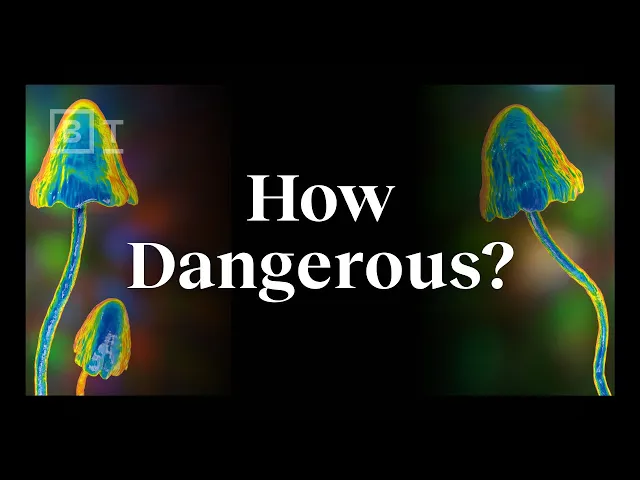
Before any of the hopeful material
There’s a good deal of encouraging research in this sequence, and we didn’t want you to have any of it before you’d had this.
Matthew Johnson has spent more than two decades running psychedelic trials, beginning at Johns Hopkins in 2004, and now leads a research programme at the Medical College of Georgia. He’s among the most published researchers in the field.
In the five-minute video, he’s careful about what the evidence does and doesn’t support, and he’s more optimistic in places than we are.
The five-minute version
If you watched it, skip ahead. If you haven’t, here’s what he covers.
Every psychoactive substance carries risk, so the useful question is what the risks are and what reduces them.
When expert panels rank substances by total harm, the results bear little relationship to legal status. Alcohol and tobacco come near the top. Psilocybin and LSD come near the bottom.
Relative to other psychoactive substances, he says, psychedelics are “really freakishly physically safe.” For most people there’s no known lethal overdose amount for psilocybin or LSD.
Classic psychedelics aren’t addictive, though they can be used in ways that harm someone.
Challenging experiences are real and relatively rare. When people are seriously hurt it’s usually because they panicked and then did something dangerous: fell from a height, walked into traffic.
A great deal of the historical fear was manufactured, and the mid-century research that produced the most alarming results was conducted in ways nobody would now defend.
The main thing separating riskier use from safer use is the presence of a sober guide.
Three things worth pressing on:
1. What the harm rankings actually measure.
The best known of these analyses is a 2010 study in The Lancet led by David Nutt, scoring twenty substances across sixteen criteria. Alcohol came top at 72 out of 100. Heroin scored 55, crack cocaine 54, tobacco 26, cannabis 20. Psilocybin mushrooms scored 5, the lowest assessed, with LSD at 7.
Two things about that scale change how you should read it. Much of alcohol’s score comes from harm to other people rather than to the drinker: violence, road deaths, family breakdown, cost to the state. And a scale measuring total harm across a population is partly measuring how many people use the substance. Most British adults drink. A very small fraction take psilocybin.
None of that makes the finding wrong. It does mean the number answers “what does this cost a country” rather than “how risky is one session for one person.” Those are different questions, and only the second one is yours.
2. “No known lethal overdose” and “nobody dies” are not the same claim.
The first is true and toxicological: the substance itself is very unlikely to stop your heart. The second isn’t claimed by anyone, and Johnson himself supplies the counterexample thirty seconds later, when he describes people dying after panicking during an experience.
Both facts are in the same five minutes, and the film never connects them. It’s worth connecting. The thing that kills people in his own examples is a fall, or a road. The toxicology is reassuring and almost beside the point.
3. “Relatively rare” is carrying weight it hasn’t earned.
He doesn’t quantify it, and the honest reason is that nobody can. The most cited survey of challenging experiences deliberately recruited people who’d already had one, which tells you what those experiences are like and nothing at all about how often they happen.
So “rare” here means something closer to “not the usual outcome” than to any measured rate. That’s a reasonable thing for a researcher to say in conversation. It isn’t a number you can plan around.

The pattern underneath all three
Put those together and something becomes visible that the film states in pieces but never assembles.
Work through the dangers Johnson actually names. The panic. The fall. The road. The unknown quantity. The mid-century trials where people were restrained, given enormous doses, and told nothing beforehand.
Not one of those is a property of the substance. Every one is a property of the situation the substance was taken in.
That’s an unusual risk profile, and it runs opposite to most people’s instinct. With alcohol, the substance does the damage directly: to your liver over years, to your judgement within the hour. Here, the evidence says the compound is comparatively unlikely to injure you, and the surrounding circumstances are doing nearly all of the work.
Almost every serious risk he names is a decision somebody made before anyone took anything.
That’s a genuinely good position to be in, because circumstances are arrangeable in a way that body chemistry isn’t.
It also means the common question, whether psychedelics are dangerous, is close to unanswerable as posed. The useful question is what the situation around one looks like.
You don’t have to work through these on your own. Talk them through with a guide. The intake takes about five minutes, the call that follows is free, and there’s nothing to book at the end.
What guided support is actually doing about each of them
Johnson names four conditions that make a situation safer: not alone, with someone trusted, control over the dose, and a setting where you aren’t worried about your safety. He doesn’t spell out what fails when each is missing.
That’s worth doing, because it’s the difference between a reassuring list and an actual account of why support matters.
Someone sober, present.
This addresses the specific chain in his own examples. Harm comes from panic, and then from what a frightened person does next. A second person interrupts that chain at the only point where it can be interrupted, which is between the fear and the action. Nobody can do this for themselves, because the part of you that would normally manage fear is the part that’s altered.
Someone you already trust.
A stranger can keep you physically safe. Trust is what determines whether you can be talked down at all, and it has to exist before the session, because it can’t be built during one.
A known dose.
This is the condition that’s easy to state and hardest to meet. Potency varies by species, by batch, between parts of the same mushroom. Outside a regulated programme, nobody can tell you what you have or how strong it is. A guide operating legally works with a tested, measured quantity, which removes the single largest unknown from the day.
A setting chosen in advance.
The road and the height in his examples aren’t abstractions. They’re features of the place somebody happened to be. Choosing the room beforehand removes them, and it also removes the lower-grade background worry about who might walk in, which shapes an experience long before anything goes wrong.
There are two more that he doesn’t mention at all, and both matter as much:
Screening, which happens before any of this.
The dangers change considerably for someone with a family history of psychosis or bipolar disorder, certain heart conditions, or several common medications including some antidepressants and lithium. These aren’t edge cases and they’re not obvious from the inside. A screening conversation is the only step that catches them, and it happens weeks before the question of setting arises.
The film is about the session. A growing body of research suggests what follows matters as much as the day itself, and an experience left unprocessed can sit badly in a way that has nothing to do with how the session went.
So how risky are psychedelics?
Johnson’s own summary is the fairest short answer available: there are very real dangers, we know what they are, and they’re less prevalent than the harms from substances most people never think twice about.
What we’d add is that “we know what they are” is the important half of that sentence, and it’s doing more work than it appears to. Knowing what the dangers are means they can be designed out in advance.
The panic has an answer. The road has an answer. The unknown quantity has an answer. The person who shouldn’t be doing this at all has an answer, and it’s a conversation that happens weeks earlier.
The risk isn’t fixed. It’s substantially a function of decisions made before the day, which is why two people can take the same thing and have experiences that aren’t comparable in any useful way.
The part an article can’t answer
Whether any of this applies to your situation depends on things no article knows: your history, your medication, what you’re hoping for, and what you’d be walking into. That’s what a first conversation is for.
Guides Collective is a low-pressure, confidential way to find out. You can see who’s available, what working with them involves, and book a free consultation call. The intake takes about five minutes and there’s nothing to commit to at the end of it.
Understand the real risks of psychedelics specific to you
You don’t have to work this out on your own. A guide can talk through what you’re weighing, and tell you plainly when a question belongs with a doctor. The call is free, with no pressure and no commitment.
Talk to a guide.
Private · No commitment · No experience needed
Frequently asked questions
Is it true there’s no lethal overdose? That’s what Johnson says, and the toxicological evidence supports it for psilocybin and LSD in most people. It’s a narrower claim than it sounds. It means the substances are unlikely to kill you directly, and says nothing about accidents during an experience, interactions with medication, or cardiac risk in someone with an existing condition.
Are psychedelics addictive? Classic psychedelics aren’t considered addictive the way alcohol, opioids or stimulants are, and they don’t produce the same compulsive pattern. Johnson is clear they can still be used in harmful ways. Not addictive and not risky are separate questions.
How common is a challenging experience? Nobody has a trustworthy figure, and anyone offering one is going past the evidence. The largest survey on the subject recruited people who’d already had a hard time, so it describes what those experiences are like rather than how often they happen.
What reduces the risk most? On Johnson’s account: someone sober present, a person you trust, a known quantity, and a setting where you aren’t worried about your safety. We’d add screening beforehand and support in the weeks after. Every one of those is arranged in advance, which is the encouraging part. They’re decisions rather than chances.
Sources and further reading
Big Think, The real risks of psychedelics, explained by an expert, Dr. Matthew Johnson
Imperial College London, Alcohol most harmful drug based on multicriteria analysis
________________________________________________________________________
This article is for educational purposes only. Not medical, therapeutic, or legal advice.
Learn More


Join our newsletter
No spam, unsubscribe anytime.