Should You Take Psychedelics Alone? What Researchers Actually Recommend
David Nutt answers the question in seventeen seconds. Then there’s everything his answer leaves out: dose you can’t verify, a room nobody checked, and the weeks afterwards that decide whether any of it sticks.
Karina Allen
|

Every published safety protocol in psychedelic research says the same thing: someone sober stays with you, start to finish. Whether that’s genuinely necessary or just institutional caution is a fair question, and it deserves a straight answer.
Here’s one from someone with nothing to sell.
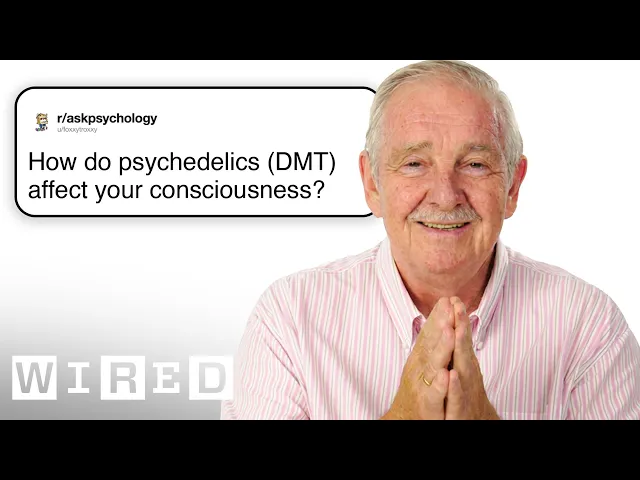
What he says, in seventeen seconds
David Nutt is a professor of neuropsychopharmacology at Imperial College London, and he used to chair the UK government’s Advisory Council on the Misuse of Drugs. WIRED asked him what to do when an experience turns overwhelming.

His reasoning is simple. That person’s job is to remind you what’s real. That you’re still yourself. Still in the room you’re in. Still alive. When things get hard, the part of your mind that would normally calm you down is the part the substance has changed.
We could have told you that ourselves. But we’re the company that connects people with guides, so you’d be right to discount our answer, and nobody should have to take a sales pitch on trust. Nutt isn’t selling anything.
People have done this on their own for a very long time, and plenty of them describe it as among the most valuable experiences of their lives. Plenty do it alone and come through fine, so none of what follows is a prediction that something will go wrong.
But the longer you look at what a guide actually does, the clearer it gets that the case for not being alone has less to do with rescue than with everything settled before you start, and everything that happens after you finish.
What those seventeen seconds leave out
Nutt is describing the moment things get difficult. That’s the moment nearly everyone pictures when they imagine this going wrong, and it’s where a second person is most obviously useful.
It’s the smallest part of the job.
By the time anyone needs calming down, most of what decides how the day goes has already been settled.

Before: what gets decided before anything is taken
Whether you should be doing this at all. Some conditions make a psychedelic experience a much worse idea, and several of them aren’t obvious from the inside. A family history of psychosis or bipolar disorder counts, even if you’ve never had an episode yourself. So do certain heart conditions, and a number of common medications including some antidepressants and lithium. On your own, you have to know which questions to ask yourself, then answer them honestly with nobody checking your work.
Where it happens. Stairs. A road. Water. A door that locks, or doesn’t. A housemate who gets home at six. A phone that rings. None of it matters on an ordinary Tuesday. Across six hours of altered perception it matters enormously, and the reason to settle it beforehand is that nobody is in any state to settle it later
What happens if something goes wrong. Who gets called. What gets said. Where the nearest help is. Ten minutes of conversation, and impossible to have at the moment you need it.
What you’re actually taking. Whatever the substance, an unregulated supply can’t tell you the dose. Mushroom potency varies by species, by batch, between a cap and a stem, and between fresh and dried. Tabs cut from the same sheet of blotter aren’t always the same strength, and what’s sold as LSD is sometimes not LSD at all. Pressed pills and powders rarely match their description. Weighing something on a kitchen scale gives a feeling of precision the material hasn’t earned.
Picture two friends taking what each believes is a moderate dose from the same bag. One has a long, manageable afternoon. The other is somewhere else entirely within the hour, having taken the same weight of a far stronger part of the batch. Neither of them was careless. They simply had no way to know.
During: what people mean by a “bad trip”
First, the reassuring part. Deciding to do this doesn’t commit you to a hard time. Plenty of people never have one.
Nobody can tell you the odds, and it’s worth understanding why. The study people quote most often on difficult experiences is a 2016 Johns Hopkins survey, published in the Journal of Psychopharmacology. It deliberately recruited people who had already had a bad experience. It was built to describe what those experiences are like. It was never built to count how often they happen, and it can’t.
What we do know is that circumstances change the odds. The 2008 Johns Hopkins safety guidelines, which most research teams still build their protocols from, link dangerous outcomes to “unprepared individuals or uncontrolled situations,” and note that the fatal cases on record happened “in hazardous and unsupervised conditions.”
Guides who do this for a living describe the same pattern from the other side. Good preparation, the right setting, and someone experienced in the room tend to make hard stretches less likely, shorter when they do come, and easier to recover from.
So the list below isn’t a forecast of your day. It’s the reason preparation exists.
When people say “bad trip,” they usually mean one or more of these:
Panic and paranoia
The fear of losing control, or of not coming back
A dissolving sense of self that the mind can read as dying
Time and place coming loose, where minutes stretch with no sense of when they’ll end
Thought loops that replay the same idea and never resolve
Old grief arriving without warning
Waves of sadness, anger or shame that feel bottomless
Visuals that turn menacing
A loneliness some people describe as cosmic
The physical side: tremor, sweating, chills, nausea
Guides who sit with people through these call them ordinary rather than alarming, and say they pass as the session passes. What makes them hard is their timing. They arrive at the exact moment your usual way of calming yourself down may not be available.
During: what guide is actually for
Grounding. Nutt’s answer, and it’s real. Someone to say out loud that you’re still yourself, and that this ends.
Physical safety. People stand up. People go outside. People decide, with total conviction, that they need to walk somewhere. Nausea and vomiting are common, and someone lying down in an eye mask is in no position to handle either. The Hopkins protocol even covers the bathroom: a monitor walks the participant there and waits outside the door. The risk isn’t the bathroom itself. It’s the few minutes alone, and the chance of wandering off somewhere else.
Knowing the difference between an intense moment and an emergency. Most hard passages aren’t medical events, and treating them as one usually makes them worse. A small number genuinely are. Someone trained knows which is which. A frightened friend often doesn’t, and what frightened people reach for is an emergency call, which across most of the US brings legal consequences along with the medical ones.
Knowing when to do nothing. Some of the hardest stretches are the ones that need to be left alone to finish. An untrained person’s instinct is to fix it, and interrupting a difficult passage can leave someone stuck halfway through it.
Staying for the whole thing. A session runs four to eight hours. The Hopkins guidelines require at least two trained people, with one of them in the room at every moment, so the participant is never by themselves. Not for five minutes, not at hour six. That’s a long stretch of attention to hold. Friends get tired, get bored, check their phone, step out for a bit.
Picture hour three, when someone becomes certain that the people who love them have quietly gone. Alone, that’s a thought with nothing to test it against, and it can harden. With someone there, it’s a sentence said out loud, answered, and reassured.
How often, and what people say afterwards
That 2016 survey is the largest of its kind. Carbonaro and colleagues, Journal of Psychopharmacology, working with 1,993 people who had already had a difficult experience with psilocybin mushrooms. Each was asked to describe the hardest one of their life..
Which is exactly why the numbers need reading carefully. Everyone in this group was chosen because they’d had a bad time. The figures describe how bad it got for them. They are not the chance of your session going badly.
Inside that group:
10.7% said they’d put themselves or others at risk of physical harm
2.6% acted aggressively
2.7% sought medical help afterwards
62% ranked it among the ten hardest experiences of their lives
And inside that same group:
Most still called the experience meaningful or worthwhile
Half described it as among the most valuable things that ever happened to them
Both of those are true of the same people, which points straight at the part almost nobody plans for.
After: the part that decides which of those you get
Integration is the least visible stage, and probably the one that matters most. It’s the work of turning an experience into something you can actually use.
It’s also what separates the two halves of that survey. The people who came to describe a hard session as worthwhile are, overwhelmingly, the people who did something with it afterwards.
And it isn’t only about the hard ones. Picture two people who have almost the same session. Both come out with the same thing: a clear view of something they’d been avoiding, and a strong sense of what they want to do differently.
The first goes home, tells nobody, and is back at work on Monday. The insight was real. For a week or two it stays vivid. Then it thins out. Six months later they can describe what happened and still can’t quite say what changed.
The second spends an hour a week for a month with someone who has done this before. They put it into words. They work out which part holds up in daylight and which part was the dose talking. Then they turn what’s left into two or three changes small enough to actually make. A year on, those changes are just how they live.
Same session. Different afterwards.
There’s a practical reason those weeks want a second person too. People come out of this with unusual conviction, and sometimes act on it fast. Ending a relationship, quitting a job, moving serious money, all inside the same week.
A guide who has watched that pattern does something specific about it. They name it out loud, usually before the session, so you recognise it when it arrives. They separate the insight from the plan, because the sense that something has to change is often worth trusting, while the particular plan you made on day three usually isn’t. And they ask you to put a date on it: revisit this in a month, and if it still looks right, do it then. Most of the time it doesn’t survive the month. Occasionally it does, and then you act on it with your feet on the ground.
What “not alone” actually means
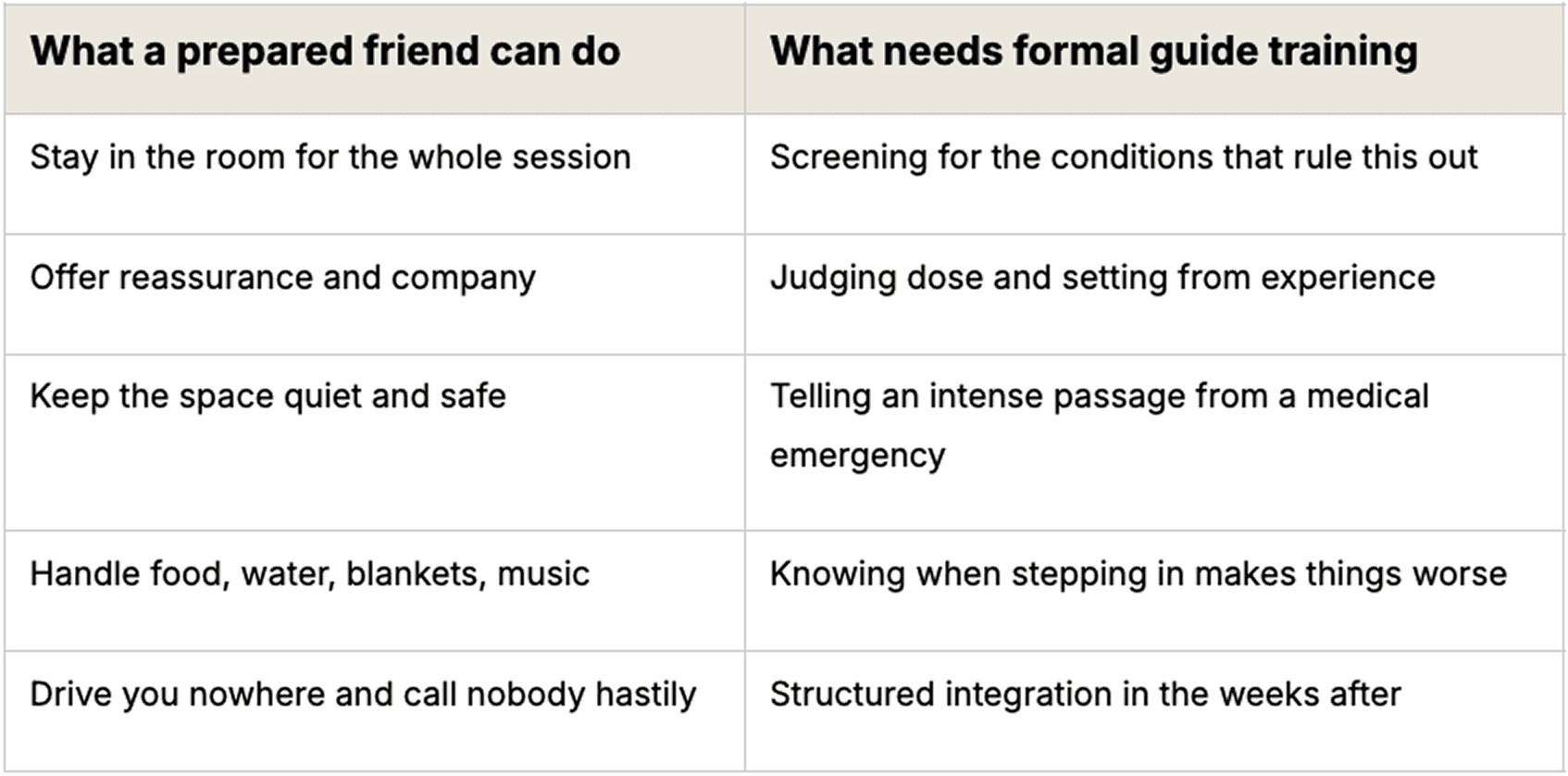
It doesn’t automatically mean a clinic. What the research describes is a sober person, prepared in advance, whom you already trust, who stays for the whole thing. In principle that can be a close friend who has read seriously and agreed beforehand what they will and won’t do.
What it can’t be is someone who’s also taking the substance, someone in the next room, or a phone.
One thing worth saying plainly. The same openness that makes those weeks valuable also leaves people unusually suggestible, which is exactly why who you pick matters as much as whether you pick anyone at all.
And if you’re weighing this up, the useful next step is smaller than booking anything. It’s working out what to ask.
So, can you do this alone?
Yes. People do, all the time, and most of them come through it fine. We’re not going to pretend otherwise.
But look again at what the question is really asking. It asks about the moment things get hard, because that’s the part everyone pictures. And that moment is the one where another person can do the least on their own, because by then the things that mattered most have already been decided.
The dose nobody could verify. The room nobody checked. The conversation about what to do if, which never happened. And then the weeks afterwards, when the experience either turns into something you understand, or something you steer around for years.
A guide spends most of their time on those. The grounding, the part Nutt describes, is real and it matters, and it’s also the last line of a much longer job.
So yes, you can do this alone. The more useful question is whether you’d want to, once you know what you’d be doing alone.
Not sure what applies to you?
Guides Collective is an informational platform. Answer a few private questions, get connected with vetted guides, and start with a free consultation to talk through your situation.
Start the free 5-minute questionnaire
Private · No commitment · No experience needed
Frequently Asked Questions
Can a friend do this instead of a guide? In principle, yes, if they’re sober, prepared, someone you already trust, and willing to stay for the whole session. What a friend usually can’t do is screen for the conditions that rule this out, judge dose and setting from experience, tell an intense passage from a medical emergency, or run structured integration afterwards. Worth being honest with yourself about which of those matter for your situation.
Does any of this change if I’ve done it before? Less than people expect. Experience helps with the parts that are familiar and does little for the parts that aren’t, and the research protocols don’t relax their requirements for experienced participants. Dose, setting and what happens afterwards still carry most of the weight.
What actually happens in preparation? In the research setting it’s several meetings before the session. Johns Hopkins used at least eight contact hours across at least four meetings, covering history, intentions, what the experience may involve, and what the person in the room will and won’t do. The point is that the relationship already exists by the time it’s needed.
Is it legal to have someone sit with me? That depends entirely on where you are and what’s involved, and it isn’t something we can answer for your situation. Psilocybin services are legal under state programs in Oregon and Colorado; elsewhere the picture is different. Worth getting local information rather than general reassurance.
Sources and further reading
David Nutt, Neuroscientist Answers Psychedelic Therapy Questions — WIRED, 18 August 2026. The quoted answer is at 3:04.
Johnson MW, Richards WA, Griffiths RR (2008). Human hallucinogen research: guidelines for safety — Journal of Psychopharmacology 22(6):603–620. Free PDF here.
Carbonaro TM et al. (2016). Survey study of challenging experiences after ingesting psilocybin mushrooms — Journal of Psychopharmacology 30(12):1268–1278. Free PDF here.
Johns Hopkins Medicine, Researchers urge caution around psilocybin use — 30 December 2016. The plain-English summary of the study above.
_______________________________________________________________________________
Not medical, legal, or therapeutic advice. Any decision about medication belongs with a licensed prescriber.
Learn More


Join our newsletter
No spam, unsubscribe anytime.