Is Taking Psychedelics Just About Getting High?
Most people see psychedelics as a recreational thing, so the assumption is reasonable. What's harder to come by is the mechanism underneath, and it isn't the one you'd guess. Four minutes from NOVA on what the scans show, what researchers now think the brain is doing during those hours, and why the weeks afterwards may matter more than the session itself.
Karina Allen
|

It's a fair assumption
Almost everyone sees psychedelics the same way. A story about a festival, a documentary about the sixties, a friend who took mushrooms at a wedding. Presented like that, the conclusion writes itself. People take them to feel something unusual for a few hours, and then it's over.
So the question underneath is reasonable, and most people never say it out loud. If this is a few hours of feeling strange, why have universities and hospitals spent decades and a great deal of money on it?
The answer is that something specific happens in the brain, and it isn't what most people picture.
Here's NOVA, the PBS science documentary series, on the first part:
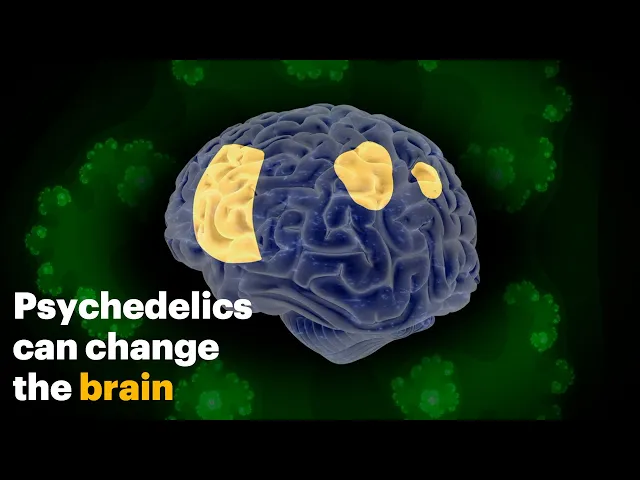
What the scans actually show
Those four minutes come from NOVA, the science documentary series that's run on PBS since the 1970s, produced by GBH Boston. It's public television, which matters here: there's no sponsor with a product riding on the answer. The film was reviewed by David Nichols and Natalie Gukasyan, both researchers in the field.
The film covers the headline finding. Here's what sits underneath it:
The network that narrates you goes quiet.
The default mode network is the circuitry that runs when you aren't doing anything in particular. It's the background process behind daydreaming, replaying yesterday's conversation, and rehearsing tomorrow's.
It's also closely tied to the sense of being a continuous self with a story. Under psilocybin and other psychedelic substances, its activity drops.

A structure that touches everything goes quiet with it.
The claustrum is an extremely thin sheet of neurons buried in the cortex, and it reaches out to nearly every other region of the brain.
Francis Crick, who co-discovered the structure of DNA, spent his last years arguing it might be where consciousness gets coordinated.
In a 2020 Johns Hopkins study, fifteen people were scanned after psilocybin and after a placebo. Claustrum activity dropped by 15 to 30 percent, and the bigger the drop, the stronger the subjective experience.

Regions that don't normally talk start talking.
With the usual hierarchy loosened, parts of the brain that rarely communicate directly begin exchanging signals.
Researchers describe the result as a temporarily less constrained brain, running patterns it doesn't normally run.
Why this isn't the same thing as getting high
Here's the part that answers the question.
Most recreational substances work by adding something. A stimulant adds energy and alertness. A depressant adds calm and takes the edge off. Alcohol, caffeine, nicotine: each one supplies a sensation you didn't have; the sensation fades, and you return to exactly where you started.
What the scans describe under psychedelics is close to the reverse. Nothing is being added. A constraint is being lifted. The network that keeps you running your habitual patterns relaxes its grip, and for a few hours the brain organizes itself differently than it has in years.
That distinction is the entire reason this is studied at all. You can't build a therapy on a sensation that fades. You can potentially build one on a window in which the patterns themselves become briefly negotiable: the rumination loop, the story about yourself you've repeated so long it stopped sounding like a story.
Whether a given person walks through that window, and what they find there, is a separate question. But the mechanism is a different kind of thing from intoxication, and that's not a marketing claim. It's what the imaging shows.
The window has a length
This is the finding that reframed the field, and it's the one most people haven't heard.
In 2023, a team led by Gül Dölen published work in Nature on what are called critical periods. These are windows early in life when the brain learns a particular kind of thing unusually easily, and which then closes. Learning a language as a small child is a familiar example.
Her team found that psychedelics reopen one of these closed windows. More striking still, the window stayed open for different lengths of time depending on the substance, and those lengths roughly tracked how long the acute experience itself lasts.
Two things have to be said plainly about this. It was done in mice, not people, and nobody has yet demonstrated the same windows in humans. And the durations are from animal work that may or may not translate.
But if it does translate, it rearranges how you'd think about the whole thing. The session stops being the event and becomes the opening of one.

The brain may stay unusually open for weeks after the session ends, not hours.
What a guide does with that window
Everything above makes an awkward kind of sense of something people in this field have said for decades without being able to prove it: the session is the smallest part.
If the brain is temporarily loosened, then what surrounds it stops being the atmosphere and starts being the input. The state doesn't choose what it reorganizes around. The person's intentions, the room, who's present, what gets talked about in the days afterwards, all of it lands on a brain that's unusually receptive and then gradually isn't.
Dölen put the implication directly, describing the time after a session as:
An opportunity for a post-treatment integration period to maintain the learning state.
Which is a researcher's way of saying what guides have been saying all along. The weeks afterwards are when it's decided whether anything holds.
A trained guide works across all three stages for that reason.
Preparation settles what you're bringing in, because an open system will work with whatever it's given. The session itself is held by a real person who knows what's happening and can keep the experience safe and grounded. And integration is the structured work of turning the session into something durable while the window is still open.
If what you'd rather do is ask someone these questions directly instead of reading more of them, that's what a first conversation is for. The intake takes about five minutes, and the follow-up consultation call is free, with nothing to book at the end. |
Where the research still has work to do
Being straight about the limits is the only thing that makes the rest worth reading.
The critical-period work is in mice. The durations are mouse durations. Whether human brains do the same thing is an open question, not a finding.
Fifteen people in the claustrum study. Small, and a single result that hasn't been widely replicated.
The default mode network story is the leading model, not a settled fact. It's a useful description of what the scans show, and it's still a description.
Blinding is close to impossible. Everyone knows whether they received psilocybin, so expectations shape every result, and nobody can fully subtract them.
A mechanism existing is not a promise of benefit. These are averages across study populations under controlled conditions, with screening, preparation, and support in place.
So, is it just about getting high?
For the hours it lasts, it's genuinely an altered state, and nobody honest will tell you otherwise.
But the reason it's being studied has nothing to do with those hours. It's that the imaging describes something unlike intoxication: a temporary loosening of the patterns you normally run on, rather than a sensation layered on top of them. And the newer work suggests that loosening may persist well past the afternoon.
If that's right, then the interesting question was never whether it feels like anything. It's what you do with a brain that's briefly willing to reconsider.
What this would actually involve
If the question you're left with is what this would actually involve for you, that's the one an article can't answer. Guides Collective is a low-pressure, confidential way to find out. You can see who's available, what working with them involves, and book a free consultation call without committing to anything.
Start with a real person.
Tell us a little about your situation, privately. We’ll connect you with vetted guides whose experience fits what you’re looking for, and your first conversation is free. No pressure, no commitment.
Talk to a guide.
Private · No commitment · No experience needed
Frequently Asked Questions
If the brain changes are temporary, what's actually lasting? Two different measurements get confused here. The scans show sharp changes that fade within hours as it clears. The durability findings come from questionnaires and personality measures taken weeks and months afterwards, and from the newer animal work on how long the brain stays receptive. One is about the afternoon. The other is about what follows it.
What is the default mode network, in plain terms? The circuitry that runs when you aren't focused on a task. Mind-wandering, self-reflection, replaying the past and rehearsing the future. It's closely associated with the sense of being a continuous self, which is why quieting it produces the experiences people find hard to describe.
Does this mean psychedelics aren't addictive? Classic psychedelics aren't generally considered addictive in the way alcohol, opioids or stimulants are, and they don't produce the same pattern of compulsive use. That's a separate question from whether they're safe for a given person, which depends on medical history, medication and circumstances.
Does any of this mean it would work for me? The research is reason to take the question seriously. It isn’t a prediction about any one person, because these findings describe groups rather than individuals. Whether it fits your situation depends on your history and what you’re hoping for, which is a conversation rather than a statistic.
Sources and further reading
NOVA PBS, How Psychedelics Change the Brain, 21 October 2022
Johns Hopkins Medicine, Psychedelic drug psilocybin tamps down brain's ego center, 4 June 2020
Johns Hopkins Medicine, Psychedelic drugs reopen critical periods for social learning, 14 June 2023
______________________________________________________________________
This article is for educational purposes only. Not medical, therapeutic, or legal advice.
Learn More


Join our newsletter
No spam, unsubscribe anytime.