Is Taking Psychedelics Just Getting High? What the Research Measures Afterwards
It’s a fair question, and the honest answer opens with a concession. For the few hours it lasts, the overlap with ordinary intoxication is real. What separates them shows up afterwards: researchers have measured a personality trait still changed more than a year after a single session, long after the brain had returned to normal. Below, four minutes from NOVA on what happens during, the Johns Hopkins work on what’s left after, and a straight account of what none of it proves.
Karina Allen
|

For the few hours psychedelics lasts, there’s real overlap. You feel different, and anyone telling you otherwise is selling something. What separates the two shows up afterwards, in what’s still measurable once the drug has gone.
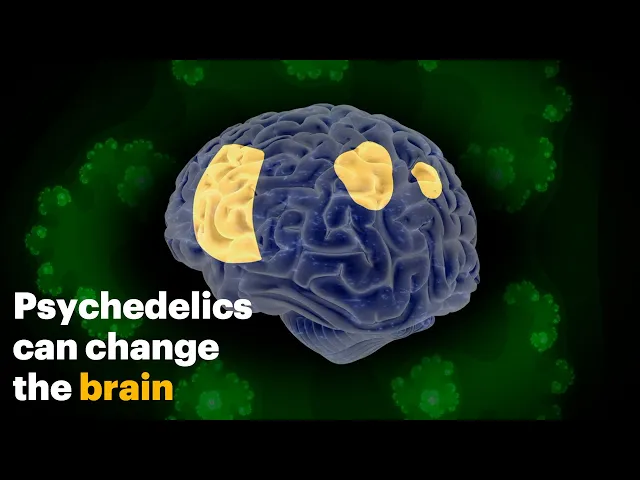
Here’s NOVA on the first part.
The part worth conceding
It’s a fair question, and most people don’t ask it out loud because asking feels impolite. The serious version goes like this. If a psychedelic session is mostly a few hours of feeling strange, why would universities and hospitals spend decades and a great deal of money studying it?
And for those few hours, the overlap is real. Perception shifts. Time behaves oddly. You are, in the plainest sense, intoxicated. Pretending otherwise is the kind of overselling that makes people stop listening.
What distinguishes the two turns up later, in what remains after the drug has cleared.
What NOVA is showing you
Those four minutes cover the mechanism: the brain’s default mode network going quiet, a thin sheet of tissue called the claustrum, and what happens when regions that don’t normally talk to each other start doing so. The film was reviewed by David Nichols and Natalie Gukasyan, both researchers in the field, and PBS has nothing to sell you.
We’ve written about the mechanism in more depth elsewhere. One piece of it is worth pulling out here, because it answers the question more directly than the rest.
The claustrum
The claustrum is an extremely thin sheet of neurons deep in the cortex, and it reaches out to nearly every other region of the brain. Francis Crick, who co-discovered the structure of DNA, spent his last years arguing it might be where consciousness gets coordinated. Nobody is certain what it does.
In a 2020 Johns Hopkins study, fifteen people were scanned after psilocybin and after a placebo. Activity in the claustrum dropped by 15 to 30 percent, and the way it communicated with regions handling attention, memory and decision-making changed. Larger drops went with stronger subjective effects.
Fifteen people is a small study, and the researchers were careful about what it shows. But it’s a different kind of finding from “this substance is a sedative.”
What’s left when the drug has gone
Here’s the part that actually answers the question.
Alcohol wears off and returns you to yourself. That’s the arrangement. Whatever happened was real while it lasted, and then it’s a memory.
The psychedelic research measures something else. In a Johns Hopkins study published in 2011, openness, one of the five traits psychologists use to describe personality, was significantly higher after a high-dose psilocybin session. In participants who’d had a mystical-type experience, it was still elevated more than a year later.
The researchers set that against what’s normally true. Core personality traits are, in their words, “predominantly stable after age 30,” and to their knowledge no previous study had shown personality change in healthy adults.
That’s the claim worth sitting with. Not that the afternoon was profound. That something was still different a year after the afternoon ended.
The finding that fits least
There’s a second result that doesn’t match the intoxication model at all.
With a recreational drug, more of it produces more effect, and that’s roughly the whole story. In the psychedelic research, how meaningful the experience was predicts what happens afterwards. The openness change appeared in people who’d had what researchers call a complete mystical experience, and not reliably in those who hadn’t.
Nobody gets better year-later outcomes from a more meaningful night of drinking. That this measurement exists at all, and does predictive work, is itself part of the answer.
What none of this proves
Being straight about the limits is the only thing that makes the rest worth reading.
Fifteen people in the claustrum study. Small, and a single finding that hasn’t been widely replicated.
The researchers’ own conclusion is hedged. They write that the findings “suggest a specific role,” not that they establish one.
The openness result appeared in participants who had a mystical-type experience. It isn’t a promise about everyone.
Blinding is close to impossible. Everyone knows whether they received psilocybin, so expectation is inside the results and nobody can fully subtract it.
The acute brain changes are mostly temporary, and we say so elsewhere on this site. The persistence claim is about what people report and what tests measure months later, which is a different measurement from the scan.
So, is it just getting high?
For the afternoon itself, there’s more overlap than most advocates will admit.
Past the afternoon, the comparison stops doing any work. Nobody runs year-long follow-ups on a night out, because there would be nothing to measure. Researchers run them here because something turns up.
That isn’t a promise about what would happen to you. It’s the reason the question is being taken seriously by people with no stake in your answer.
If the question you’re left with is what this would actually involve, Guides Collective is a low-pressure, confidential way to find out. You can see who’s available and what working with them looks like, without booking anything.
Not sure what applies to you?
Guides Collective is an informational platform. Answer a few private questions, get connected with vetted guides, and start with a free consultation to talk through your situation.
Start the free 5-minute questionnaire
Private · No commitment · No experience needed
Frequently Asked Questions
If the brain changes are temporary, what’s actually lasting?
Two different measurements get confused here. The scans show acute changes that fade as the drug clears. The durability findings come from questionnaires and personality measures taken weeks and months afterwards, when the brain has long since returned to baseline. One is about the afternoon, the other is about what people carry out of it.
Is “mystical experience” a scientific term?
It’s a measurement, not a claim about the supernatural. Researchers use a validated questionnaire scoring features people reliably report: a sense of unity, transcendence of time and space, a feeling of encountering something true. It’s used because it predicts outcomes, not because anyone is making a metaphysical argument.
Does this mean psychedelics aren’t addictive?
Classic psychedelics aren’t generally considered addictive in the way alcohol, opioids or stimulants are, and they don’t produce compulsive use in the same pattern. That’s a separate question from whether they’re safe for a given person, which depends on medical history, medication and circumstances.
Does any of this mean it would work for me?
No, and that’s worth saying plainly. These are averages across study populations under controlled conditions with screening, preparation and support. They describe what happened to groups of people. They don’t predict individuals.
Sources and further reading
NOVA PBS, How Psychedelics Change the Brain, 21 October 2022
Johns Hopkins Medicine, Psychedelic drug psilocybin tamps down brain’s ego center, 4 June 2020
This article is for education. Not medical, therapeutic, or legal advice.
Learn More


Join our newsletter
No spam, unsubscribe anytime.