What a Psilocybin Session Is Actually Like, From Someone Who Had One
Studies show averages. This one is a single story, from a Portland mother who went through Oregon's regulated program while grieving her son.
Karina AllenWhat does a psychedelic guide actually do during a session? Less than you'd think, and that restraint is the skill. Plus why the weeks after matter.
Karina Allen5 min read
A guide's main job during a session is to be a steady safety net, not to steer the experience.
Most of the skill is restraint: knowing when a challenging moment needs space to finish and when it needs a reassuring hand.
Much of the work happens before the session, when everyone can agree on a plan.
The weeks after matter too. Integration support helps turn what happened into changes that last.
People ask us this one in different words almost every week, and it always arrives sounding practical. What does the person sitting with you actually do?
It’s hard to answer well, because the honest answer is mostly “not very much.” Said plainly, that sounds like an argument for skipping them entirely.
In the video above, Matthew Johnson has the best description of the job we’ve come across, and it takes him about two minutes.
His comparison is an astronaut and ground control. One person is going somewhere. The others are on the same team with an entirely different job, and their job is explicitly not to come along.
What makes it a good analogy is the asymmetry. Ground control isn’t a smaller version of the astronaut, and it isn’t a spectator. It’s a separate role with its own competence, and the whole value of it depends on staying where it is.

"You're the astronaut, we're ground control, but we're a team." Matthew Johnson
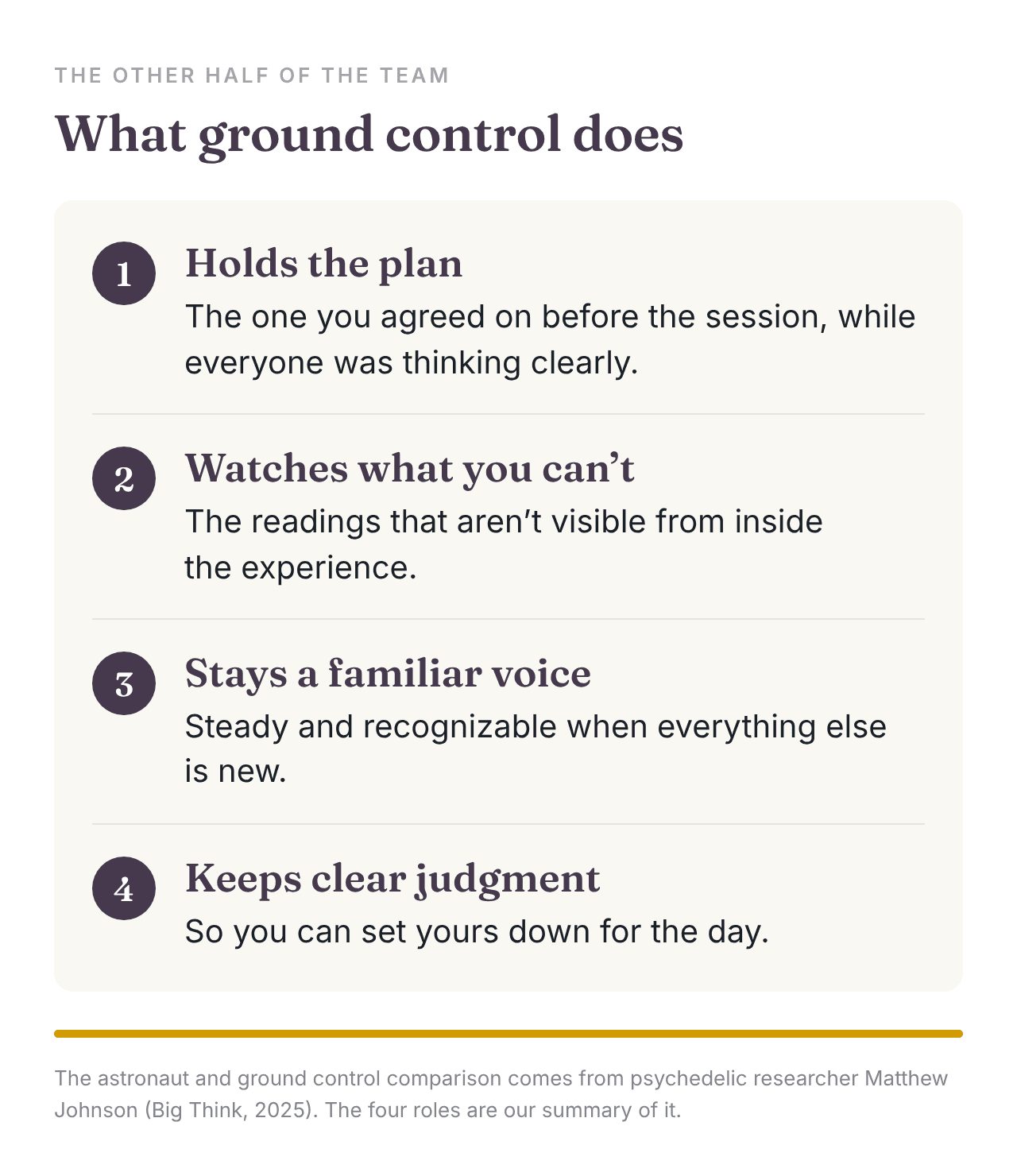
Consider what that role actually consists of.
Somebody holding the plan that was agreed before launch, when everyone was thinking clearly. Somebody watching the readings the person inside can’t see. A voice that stays recognizable when nothing else is.
And somebody whose judgment isn’t altered, which is the entire point, because the person going somewhere has temporarily given that up.
Nearly every helping role is judged by visible action. You can see what a trainer does, or a teacher, or a nurse. The work and the evidence of the work are the same thing.
This one inverts that. A guide who has done the job perfectly has, from the outside, sat quietly in a room for six hours.
"[The guide's] job at that point is as a safety net."
— Matthew Johnson, PhD, psychedelic researcher
The skill is almost entirely in restraint: knowing which challenging passage needs to be left alone to finish, and which needs a hand on the arm, and not confusing the two.
That’s genuinely hard, and it’s harder to hire for, because an untrained person’s instinct in the presence of distress is to intervene. Interrupting something that needed to complete can leave a person stranded halfway through it.
Which is why the answer to “what do they do” never sounds impressive. Most of the expertise is in what doesn’t happen.
If you’ve read this far, the question you’re weighing probably isn’t whether to do this at all. It’s whether there’d be anyone steady on the other end of it. That’s exactly what a first conversation is for, and it costs nothing to find out. The intake takes about five minutes, and the consultation call after it is free with nothing to book at the end.
Then Johnson says something about the day afterwards that we weren’t expecting.
It’s about what it’s like to try to tell the people closest to you what happened. You come home with something that rearranged how you see a relationship, or your work, or yourself, and the people you most want to tell have no frame for it.
They listen kindly. They fold it politely into normal conversation. And then everybody moves on to what’s for dinner.
Nobody did anything wrong in that exchange. It’s simply that an experience like that doesn’t survive casual retelling, and the gap between how much it mattered to you and how it lands at the table is its own particular loneliness.
We haven't seen that in any study. It’s also most of the reason integration exists.
The gap between how much it mattered and how it lands at the table is its own kind of loneliness.
There’s a reason this matters more than it sounds.
Research into how long the brain stays unusually receptive after a session suggests a window measured in weeks rather than hours. If that holds, then the weeks after the session are when whatever happened either consolidates into something durable or quietly fades.
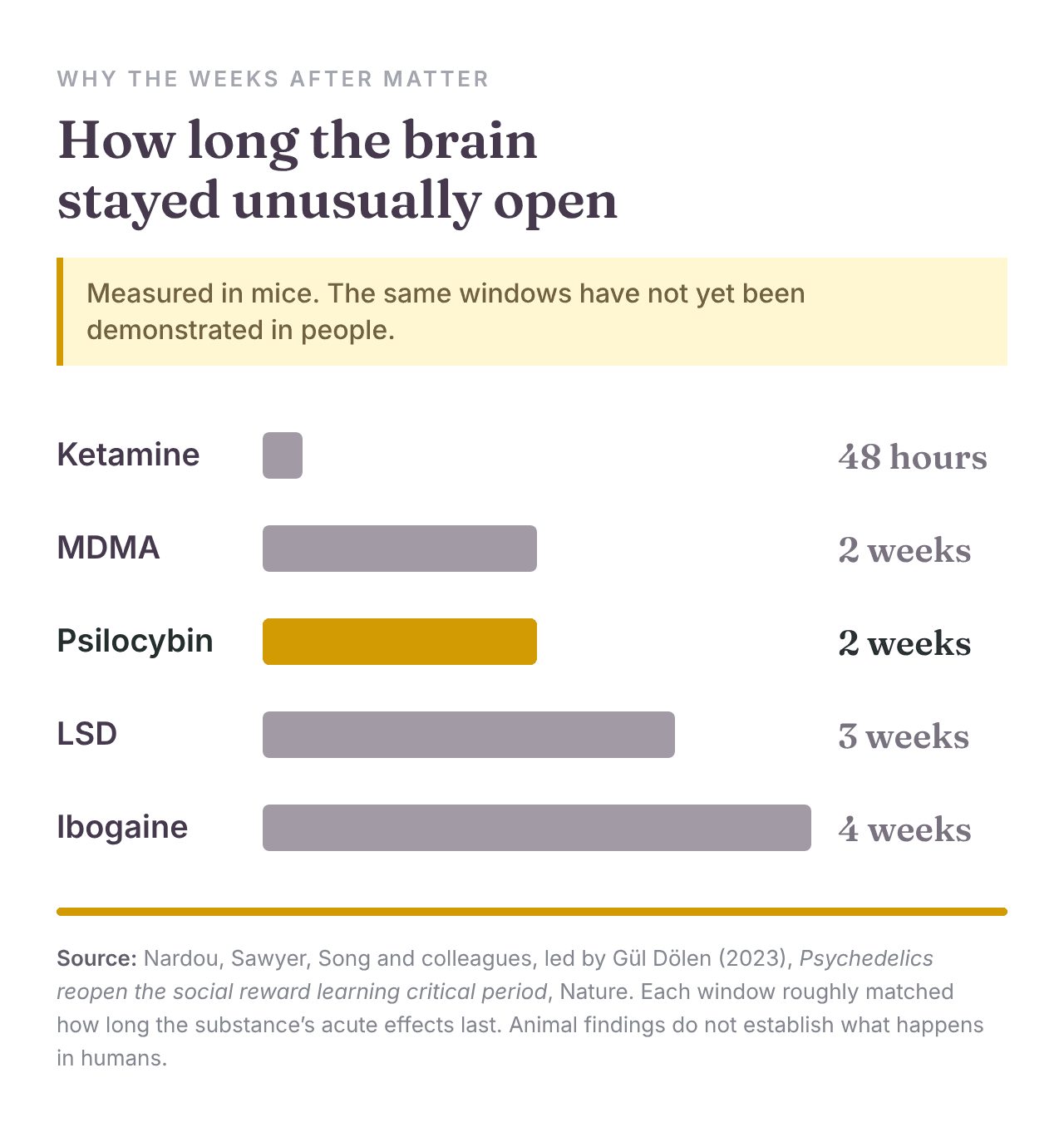
Now consider what usually fills those weeks.
A couple of attempts to explain it to people who care about you and can’t quite meet it, a gradual decision to stop trying, and a slow return to normal. The window is open the whole time, and almost nothing is going into it.
That’s the problem integration exists to solve, and it’s the half of a guide’s job that happens when the session is long over.
Somebody who was there, who doesn’t need the experience explained from scratch, and who can help turn it into something specific enough to act on while it’s still live.
Most people spend the weeks after a psychedelic experience explaining it to people who can’t quite understand it. A qualified guide is the one who doesn’t need it explained. Your first conversation is completely free.
Talk to a guide
Private · No commitment · No experience needed
Can a friend do this instead? For the session itself, sometimes, if they’re sober, prepared, trusted and willing to stay the whole time. The part that’s harder to improvise is the restraint, and the part that’s hardest is the weeks afterwards, when a friend who was also there has their own version of events rather than any training in helping you make sense of yours.
What does integration actually involve? Usually conversation, over several sessions in the weeks following. The work is turning an experience into language, then into a small number of changes concrete enough to actually make. It’s unglamorous and it’s the part most associated with whether anything lasts.
Is a guide the same as a therapist? No. Guides are psychedelic-informed and work within specific boundaries. Many aren’t licensed clinicians, and the role isn’t therapy. Anyone considering this alongside existing mental health treatment should talk to their own clinician about it.
This article is for educational purposes only. Not medical, therapeutic, or legal advice.
Ready to talk it through? Start with a free intake and meet guides who fit you.
Find a Guide
Studies show averages. This one is a single story, from a Portland mother who went through Oregon's regulated program while grieving her son.
Karina Allen
Matthew Johnson has spent two decades running psychedelic trials. In five minutes he lays out what the evidence supports about risk, which is more reassuring than…
Karina Allen
Ayahuasca — the Amazonian plant brew known as the "vine of the soul" — sits where centuries-old ceremony meets modern brain science. This guide covers what ayahuasca…
Karina Allen